
Anatomy of a title field
If you are interested in MaRC cataloging, the first field to master is the 245– also known as the title field. When I started this blog, I imagined a nice, succinct post on the title field. I no longer think this is possible. I still think mastering the 245 makes for a good introduction to MaRC cataloging. I just no longer it’s possible to be succinct when when discussing title fields (or anything else in a MaRC record).
Instead, I’m going to write a long post. If you have enough on your plate already and aren’t ready to take on original cataloging, skip this entry. If you’re curious and if you enjoy detailed work, get yourself a nice cup of the beverage of your choice (with a lid if you’re on the Desk) and settle in.
Here goes, a typical title field:
| 245 | 14 | The problem with titles :|ba not so brief introduction /|cby Ellen Moore; illustrated by E. Sarjeant |
Here’s the breakdown:
245 is the line number for the title field. 245 is computer code that can be read by library systems around the world to mean this line holds the title information.
14 is also computer code. The indicator numbers in this column space give the system important information about how to handle this title. The 1 tells the computer that the author’s name in the 100 field is the first point to look to when filing this record (author main entry). If there were no author name in the 100 field, instead of reading 14, the space in this column would read 04. The 0 tells the computer that the title is the main entry. The 4 indicates that there are 4 non-filing spaces when sorting this title alphabetically: T-h-e-[space]. When sorting titles, the word “the” is a skip word. (To better understand which fields require indicator numbers and how they function, I always keep a tab open to the handy reference guide provided by OCLC at https://www.oclc.org/bibformats/en/2xx/245.html
Capitalization: Notice that the convention for capitalization for titles in a MaRC record is different from the convention for capitalization of a title in almost any other context. It’s more like how we apply capitalization in a sentence—first letter of the title and all proper nouns. Understanding the conventions helps when choosing which record to import from SmartPort. If the record doesn’t follow cataloging conventions for capitalization, I wonder what else is wrong with the record.
Subfields: In Workflows, all subfields are denoted with a vertical pipe | and a lower-case letter. Again, we’re writing computer code– the pipe and letter combination tells the system how to read that subfield and apply that bit of information to the public interface. Again, consult the OCLC guide: https://www.oclc.org/bibformats/en/2xx/245.html for a more detailed breakdown on choosing and applying subfield codes. Notice that in OCLC, they use the ǂ symbol to denote subfields instead of the |. In many Library of Congress examples, I’ve seen the $ symbol used. There are other symbols used by other systems, but they serve the same function. You will get used to the pattern if you spend a lot of time around MaRC records.
|a Often in Workflows the first subfield in the title statement, subfield |a, is not coded; it is understood that the main title information, the title proper, comes first. In my example above, I don’t include a “|a” at the beginning of the title proper because Workflows doesn’t require it.
Title information is transcribed off of the title page, if there’s a title page. The wording and spelling should be exactly the same as what one sees on the title page, the capitalization should follow the convention described above. (If you think there is something confusing about the title as expressed on the title page—maybe it starts with a number or includes an & instead of the word “and”, maybe it’s worded slightly differently from the title on the spine or the cover—you will want to include a 246 field after your 245 field to accommodate other ways to search for this title.)
:|b Is for additional title information or a secondary title. Not all titles have a secondary title or additional title information. Sometime the words “a novel” follow the title proper on a title page. Think of secondary titles as a continuation of the main title. They only start with a capital letter if the first word is a proper noun. The punctuation that precedes |b is always a colon. There’s always a space before it. The pipe (|) will add another space to the display; when you see the title in the OPAC it will show a space on either side of the colon:
OPAC display: The problem with titles : a not so brief introduction / by Ellen Moore; illustrated by E. Sarjeant
The name of a series on a title page goes in a 490 field. I have seen series titles in |b, but I think series titles are better expressed in the 490 field. I go into further discussion of series information found on title pages at the end of this article.
/|c Notice the space / in the center of the line. The slash, preceded by a space and followed by |c or subfield c, separates the title from the statement of responsibility. All the information transcribed off the title page that is about the title goes in front of the slash. All the information transcribed off the title page about the writers, illustrators or editors, goes after the slash. However the author’s name is expressed on the title page, that’s what you transcribe in |c. Notice that the name is generally expressed first name first.
Sometimes you will see a difference in how the author’s name is expressed or even spelled in the /|c of the 245 from how it is expressed or spelled in the 100 line. The form of the name in the 100 line should follow the standard agreed upon by the Library of Congress; in other words, the name in the 100 field is an “authorized heading”. Maybe it includes a middle initial or dates that aren’t listed on the title page. The purpose of the authorized name headings is to differentiate from other authors with the same name and to link all the works from one creator to their other works in the catalog. (There are 16 different Ellen Moores out there with 16 unique authorized headings to differentiate which Ellen Moore is meant. Unfortunately, none of those 16 Library of Congress approved headings refer to me. Search https://authorities.loc.gov/ on your own name if you’re curious.)
If there’s no author or editor information listed on the title page, then there’s no subfield /|c in the 245.
What else?
|h This is what OCLC has to say about |h: “A medium designator used in the title statement under Anglo-American Cataloguing Rules, second edition (AACR2) and some earlier cataloging instructions. Do not use GMDs [General Material Designations] in bibliographic records. Prefer use of content, media, and carrier terms or codes in fields 336, 337, and 338 instead. OCLC began removal of existing GMDs from bibliographic records in March 2016.”
Back in the old days, you would see a lot of subfield |h use for different formats like |h[DVD] or |h[VHS] or |h[book on tape] . In 2013, when the 336, 337, 338 fields were introduced, |h was retired by OCLC and Library or Congress.
However…
|h[large print] is still in use in Michigan. There are other places in a bib record where large print can be and should be noted (the fixed fields, as a subfield in the 020 or in the 300 field) but keeping |h[large print] it in the 245 field makes it very obvious to all involved—patrons, interlibrary loan staff, and shelvers– that the record is indeed a large print record. If you distribute ILL’s to patrons, you know first hand that mistakes are made when retrieving the correct format. Using |h[large print] is a melcat standard and a UPRLC standard. It’s part of the title, not part of the statement of responsibility, so plunk it before the /.
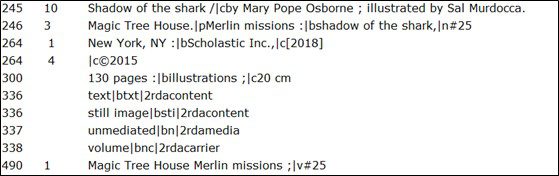
Series title
The name of the series often appears on a title page. I generally save the series name for the 490 and 800 fields. When it appears at the head of a title on a title page sometimes the line between what is the title and what is the series can be a little confusing; catalogers can add a 246 field that includes the series name to aid in discovery.
That’s all for 2025. Best wishes to all for 2026!
(As always, I’m happy to answer questions and requests for support. Please send any all to support@superiorlandlibrary.org.)