
Dewey numbers – some background and a cool tool
(Tip: scroll to boldface hyperlink toward end of this post to get to the linked tool directly.)
Not everyone loves the Dewey system. It was created by one person and reflects that one person’s bias. Melville Dewey built it quickly, it took him weeks. Library of Congress, the system used by most universities, was built by a committee. It took decades to complete it. Because Dewey is strictly numerical, precise Dewey numbers can be very long and unwieldy. LC is alpha-numeric. Some libraries have experimented with other systems such as bookstore models, meant to be more intuitive. No system is perfect.
Currently Dewey is the most widely used system in both our UPRLC libraries and libraries throughout the world. In practice, most of our libraries file fiction titles by the author’s last name and reserve Dewey for nonfiction.
Professionally constructed records downloaded via SmartPort come with an assigned Dewey number in the 082 field of the MaRC code. These Dewey numbers automatically generate a Call Number record when the bib record is imported to our shared catalog.
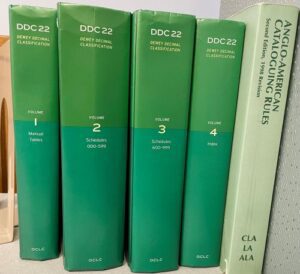
But what do you do if a record doesn’t come with a Dewy number? MCLS and other organizations offer classes periodically on how to construct Dewey numbers. I’ve taken one class and can do an OK job when needed, but I know there are others with more experience and skill generating call numbers at the larger institutions that supply MaRC records to OCLC. Traditionally, catalogers would use a four-volume set of DDC (Dewey Decimal Classification) manuals with it’s index and special tables as the go-to resource to generate numbers. I have a set—it’s a couple of decades old, but I still find them useful. In recent years, the manuals have been replaced by an online product called WebDewey that we do not subscribe to. (It’s expensive.)
If you don’t have the expertise, the manuals, or the WebDewey subscription, there other other routes. One easy hack involves examining the work in hand, determining what keywords best describe the work, and searching our shared catalog or melcat for other works that fit your description. What call number is assigned to books that would sit next to your item on the shelf?
Last fall, Lynne at Alanson Public Library introduced me to the Dewey tool available from library thing: https://www.librarything.com/mds/. I liked it as soon as I saw it– it’s free, colorful, intuitive to use. (It’s now linked onto our Cataloging Tools page.)
This week, Lynne at Ironwood Carnegie needed a call number for a book on ski jumping (A Yooper Ski Jumping Legacy by Ironwood native Craig Savonen.) I went to our catalog and found a couple of books on ski jumping that were using 796.93. I went to my manuals and looked it up, knowing that sometimes libraries with small collections will truncate a number to make it simpler. Yep, 796.93 is the more general category of skiing and snowboarding, while 796.933 is ski jumping in particular.
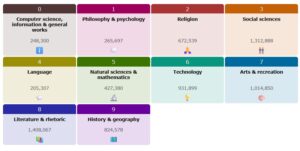
I tried the same search on the LibraryThing tool, and it was my kind of fun. Not only did I arrive at the precise location, I was able to experience the breakdown in logic that got me there. I started with “7” for arts and leisure. Clicking on the blue “7” tile opened another set of tiles that I then scrolled down to narrow-in further on my topic. Each decimal place opened a new set of tiles and choices, I kept scrolling down till I reached that just right number.
One final place to double check that you have the right Dewey number for your collection is your collection. You can search by call number in both Enterprise and Workflows to see what titles would surround your book when it’s added to a shelf. Or better yet, you could walk over to the shelf and take a look. One of the best things about working in a library is you get to work in a library– you can see first hand all those lovely books arranged in an orderly fashion on the shelf, waiting for the right user to discover them.
-
Latest News
 Registration open for the 2026 UPRLC Annual ConferenceMay 20, 2026This year’s theme is The Next Chapter! Register here: UPRLC Conference Registration SEPTEMBER 21-22, 2026 AT NORTHERN MICHIGAN UNIVERSITY […]
- Superiorland Library Cooperative’s New Director: Tricia WylieAugust 22, 2025Welcome Tricia! Tricia Wylie is Superiorland Library Cooperative’s new director. Tricia comes to us from the New River Public Library Cooperative, a small […]
- UPRLC Board of Directors Regular Meeting ScheduledApril 15, 2024The next regular meeting of the UPRLC Board of Directors will be held on Monday, June 3, 2024 at 11 AM Central/12 Noon Eastern. The meeting will be held via Zoom […]
- UPRLC Board of Directors Regular Meeting ScheduledMay 22, 2023The next regular meeting of the UPRLC Board of Directors will be held on Tuesday, May 30, 2023 at 12 PM Central/1 PM Eastern. The meeting will be held via Zoom […]